The symbols on our reels were not invented for a game. Falcons, eyes, beetles and flowers carried deep meaning on the banks of the Nile for some three thousand years. Here is the story behind each of them, as Egyptologists understand it today.
Horus and his eye
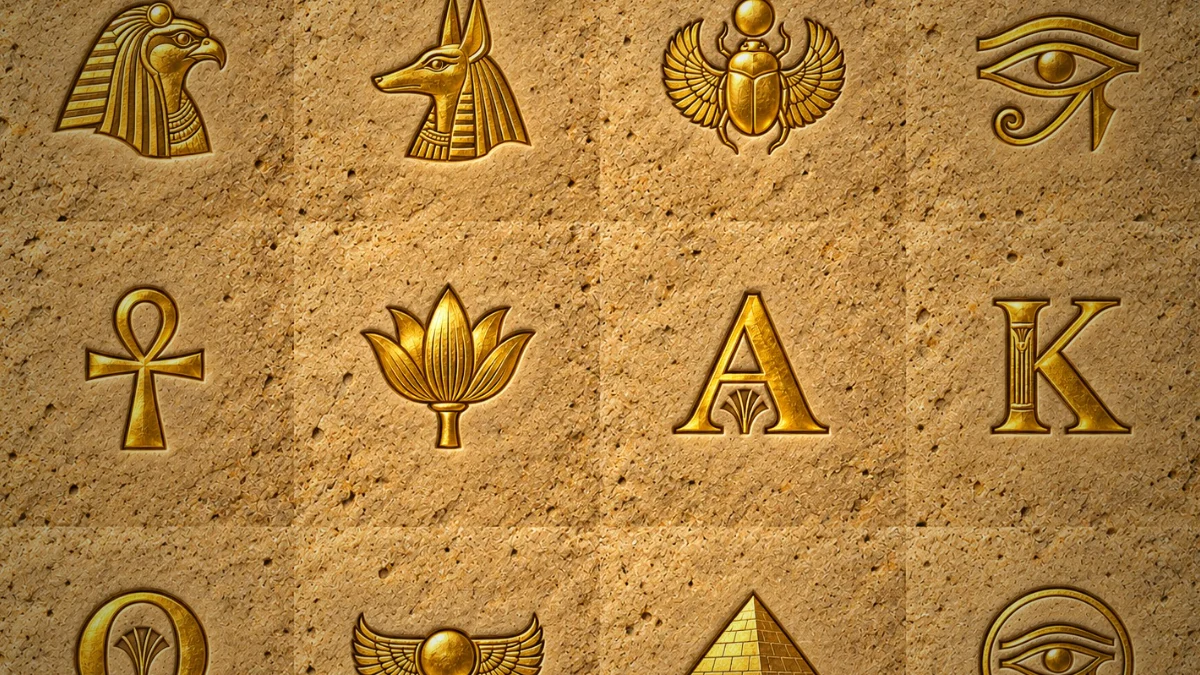
Horus, the falcon god of the sky, lends his name to our first game; the name is usually understood as “the one far above”. In the best-known myth he is the son of Osiris and Isis and fights his uncle Seth to avenge his father and win the throne of Egypt. Every living pharaoh was seen as Horus on earth.
In that struggle Horus lost an eye; in many versions of the myth, the god Thoth healed it. The restored eye became the wedjat, “the sound one”: a sign of healing, wholeness and protection, and one of the most popular amulets in Egypt.
Anubis, guardian of the dead
Anubis has the head of a jackal or wild dog, animals often seen around desert cemeteries. He was the god of embalming and the protector of tombs who guided the dead into the afterlife. In the Book of the Dead he tends the scales on which the heart is weighed against the feather of Maat, goddess of truth and order. His black color recalled the fertile Nile soil and rebirth, not death.
Ra and the winged sun
Ra was the sun god, often shown with a falcon’s head crowned by a sun disk. By day he sailed across the sky in his boat; by night he traveled through the underworld to be reborn at dawn. He and Horus even merged as Ra-Horakhty, “Ra-Horus of the two horizons”.
The winged sun, a sun disk with spreading falcon wings, was a protective emblem carved above temple gateways and linked to Horus of Behdet.
The scarab and Khepri
Egyptians watched the dung beetle roll its ball and saw the sun being pushed across the sky. Young beetles crawl out of such balls as if made from nothing, so the scarab became a sign of rebirth and of Khepri, god of the rising sun, whose name echoes the verb kheper, “to come into being”. Scarab amulets were made by the thousands, and a heart scarab was often laid on the mummy’s chest.
The ankh and the lotus
The ankh is the hieroglyph for “life”. Gods often hold it to a king’s nose, offering the breath of life. Scholars still debate what object it first depicted; a sandal strap is one suggestion.
The Egyptian “lotus” is really a water lily, most famously the blue one. Its flowers open in the morning and close again in the afternoon, so it stood for the sun’s daily rebirth. In one creation story, the young sun rises from a lotus on the primeval waters.
The pyramid
Pyramids were royal tombs, built mostly in the Old and Middle Kingdoms. Their shape is often linked to the benben, the first mound of creation, and to the rays of the sun. The Great Pyramid of Khufu at Giza rose about 146 meters and remained the tallest structure built by people for more than 3,800 years. Excavations of the nearby workers’ town suggest it was raised by organized crews of laborers, not slaves.
Bastet and the uraeus
Bastet began as a fierce lioness and over time became a gentler protector of the home, of mothers and of children. At her great temple in Bubastis, in the Nile Delta, the Greek historian Herodotus described huge, joyful festivals, and countless mummified cats were offered to her.
The uraeus is the rearing cobra worn on the brow of kings and gods. It embodied Wadjet, the cobra goddess of Lower Egypt, and was said to spit fire at the king’s enemies. Look for it on royal masks and crowns, and in pairs beside the winged sun.
Hieroglyphs
The Greek word hieroglyph means “sacred carving”; the Egyptians called their script “the god’s words”. A sign could stand for a whole word or for sounds, or act as a silent hint to meaning, and royal names were framed in oval cartouches. The script was used for more than 3,500 years: its last known inscription, on the island of Philae, dates to 394 CE. Jean-François Champollion deciphered it in 1822 with the help of the Rosetta Stone.
Where to find them in our games
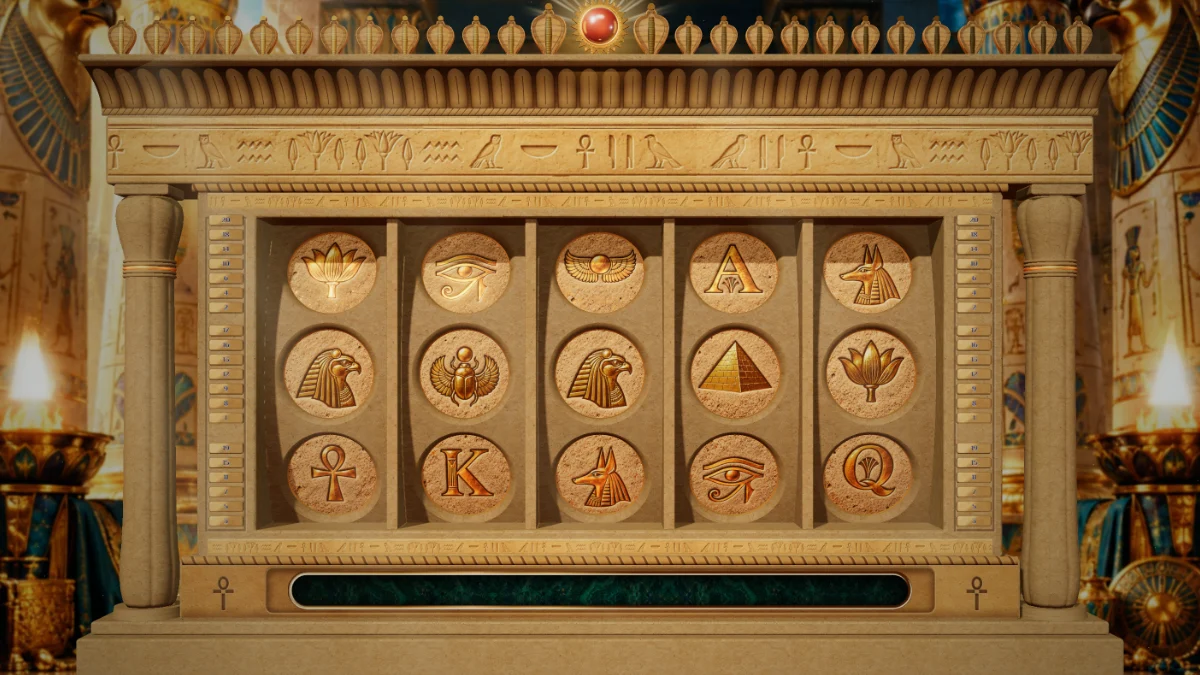
- Treasures of Horus: Horus, Anubis, the Scarab, the Eye of Horus, the Ankh and the Lotus, with the winged sun as WILD and the Pyramid as SCATTER. Carved hieroglyphs decorate its sandstone shrine.
- Pharaoh’s Tomb: the golden Pharaoh mask, Bastet as a black cat, the Eye of Horus, the Pyramid, the winged Scarab, the Ankh and the Lotus, with the temple gates as WILD.